What a Fashion Column Accidentally Taught Me About Brand Photography Presence

BRAND PHOTOGRAPHY · PRESENCE · FOUNDERS
Most founders think looking better in photos is a styling problem. Get the right outfit, find your good side, remember to smile with your eyes. They spend hours agonising over what to wear and leave the shoot wondering why the photos still don’t feel like them.
They’re solving the wrong thing.
I was reading a fashion column recently, one of those trite “8 shortcuts to ageless style” pieces that seems to just be bullshit. Somewhere around tip three I realised every point was actually about presence. Not fabric, but the way a body communicates trust before a word gets spoken. The way a photo makes someone lean in or scroll past.
So I thought let's take it and see how what's being said relates to brand photography. Here’s the translation. Not for fashion. For you, if you hate being photographed but can’t afford to keep hiding.
“We forget to be who we are. We get stuck in roles: business owner, Mrs. So-and-so. Part of what I do is help you remember.”
I said that and I meant every word. We do forget who we are. We set out to create a personal brand ( what the fuck that means I haven't a clue ) but somewhere along the line, in all the Pinterest mood boarding, Instagram following and who knows what else we slowly merge into an identikit of all that we follow. The influencers are truly influencing. Or to put it another way, the lunatics have taken over the asylum. So here's my suggestions for you ..
“My challenge is always to find the authentic, honest version of you. That’s what the shoot is actually unlocking, not a better pose. A body that’s stopped bracing.” — Jules

“When you realise you were a sitter all along, it just came far easier.” Barbara
Colour signals confidence, the fashion writer said.
In front of a camera, shape does the heavier lifting.
Most people stand like they’re waiting for a delayed train. Feet parallel, shoulders stiff, discomfort on view for everyone to see. It’s not that they look bad. It’s that they look like everyone else. In a scroll, that’s the same as invisible.
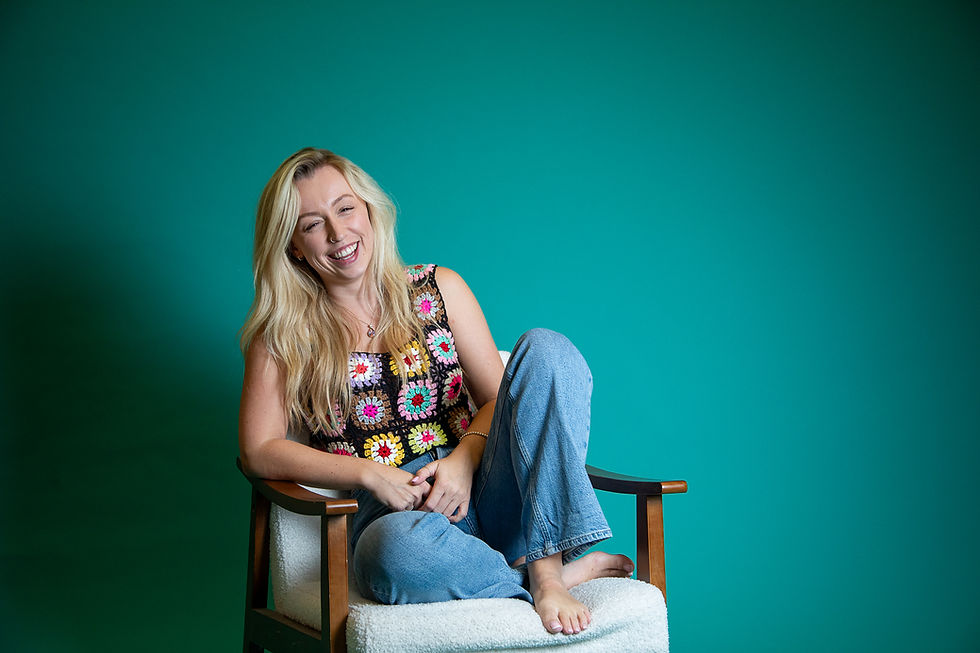
One knee bent. The shoulder dropped. The body angled away from the lens and the face turned back. These aren’t poses. They’re micro-signals that say: I’m grounded. I’m not performing. I’m just here.
Add glamour with jewellery → Give the eye somewhere to land
“There’s nowhere to hide in a really good close-up. That’s the picture. And most people never get to see themselves that way.” Jules
Jewellery works in editorial photography because it gives the eye somewhere to go. In brand photography, your hands do the same job and most people have no idea what to do with them.
Touching your collarbone. Your glasses. The cuff of your sleeve. These aren’t tricks, they’re what people do when they’re comfortable and thinking, not performing. A hand mid-gesture, or resting on a surface rather than hanging like a spare part, makes a photograph feel like a moment. That’s how you stop looking like a template.

Avoid overdoing trends → Stop performing confidence
“I have to let go of a little level of my perfectionism… let it live with an organicness.” - Sarah
Trendy poses age fast. Your clients aren’t buying the pose they’re buying whether they feel they can trust you.
Clients notice the stiffness first. They just don’t tell you. They reply to someone else instead.
Most founders who hate their photos had a bad shoot somewhere in their past. No direction. No warmth. Just: “chin down, shift right, great.” And they walked away with images of a slightly tense stranger in their clothes. That experience lives in the body. Now every camera feels like that camera.

The photos that convert are the ones where you chose one intention and let the rest be natural. Not try-hard. Not detached. Specifically, recognisably you.
Your visuals are either working for you or working against you. There’s no neutral.
Stick with what suits you → Start with what already feels like you
“I’m looking at her going: no trouble here. I’m strong and I’m proud.” - Linzi
Your best images come from positions your body already trusts. This sounds obvious until you’re in front of a camera and someone says “just be natural” and you forget how bones work.

The fix is simpler than most photographers make it. How do you stand in a conversation you’re actually enjoying? What does your face do mid-sentence, not at the full stop? Start there.
“I’m not interested in shooting contrived, non-natural versions of people. If a pose feels awkward, it reads awkward. We find what your body already knows.” - Jules
A posed photo looks posed. A present photo looks like someone worth listening to.
If you’re in a hair rut → If you’re in a pose rut
Most people repeat the same three expressions across every shoot because no one has ever coached them out of them. The stiff smile. The slight frown that reads as stern. The tipped-back chin that adds ten years and subtracts warmth.
One small experiment dissolves this: sitting instead of standing, using a wall, walking through the frame instead of stopping for it. Your body gets interested in the movement and forgets it’s being photographed. That’s the moment the real image happens.

“The first few shots are always going to be a bit funky. Then we ease into it. By the time you’re warmed up, that’s when the magic happens.” - Jules
Look on preloved sites for finds → Look at what you already have
“Acceptance is very different to positivity. Acceptance is: that’s the state I’m in now, and that’s perfectly okay.” - L
You probably already have a photo somewhere, a candid, a video screenshot, something taken at an event, where you look genuinely like yourself. Not posed. Just present.
Scroll back. Find it. Then ask what your body was doing. The lean forward. The half-smile that was real. The hands doing something rather than hanging there. That’s not luck, it’s information. A good shoot rebuilds that deliberately — not by teaching you to perform, but by reminding you what it feels like to stop.
“I’ve made you something you already were. You just didn’t know it.” - Jules
Why this actually matters
Most founders aren’t embarrassed about having bad photos. They’re embarrassed about what those photos might be costing them right now, while a potential client is looking at their LinkedIn.
Clients don’t tell you when your photos lost you the contract. They just reply to someone else. Choose the person who looked like they’d already worked at that level.
The real fear, the one no one says out loud, isn’t “I look bad.” It’s “What if I look like everyone else, and no one can tell the difference?”
You don’t have an appearance problem. You have a presence problem. Presence is fixable. That’s exactly what a well-directed shoot is for.
“Photography is a byproduct. What we’re really doing is a huge shedding moment. A huge open to the world.” - Jules
Presence-led photography exists for exactly that problem. Not to make you look professional. To make you look like you, specific, recognisable, worth the conversation. The photographs become a mirror that finally works.
READY TO STOP HIDING?
Three ways to take the next step
Option 1 — Book a free 20-minute Photo Audit
Bring your current images. I’ll show you three specific things that are working against you and what one session could change. No pitch, no pressure. You’ll leave knowing more about your visual presence than you did walking in.
Option 2 — Send me your current headshot
Email it. I’ll reply within 24 hours with three honest, specific observations about what it’s communicating right now. Not a sales email. An actual response. If you’ve been wondering whether your photos are the problem, this will tell you.
Option 3 — Read the case studies first
Not ready yet? Start with the client work. Real founders, real results. No stock images, no retouched nonsense — just what happened when they stopped hiding.
Safe visuals disappear in a scroll. You’ve been safe long enough.


Comments